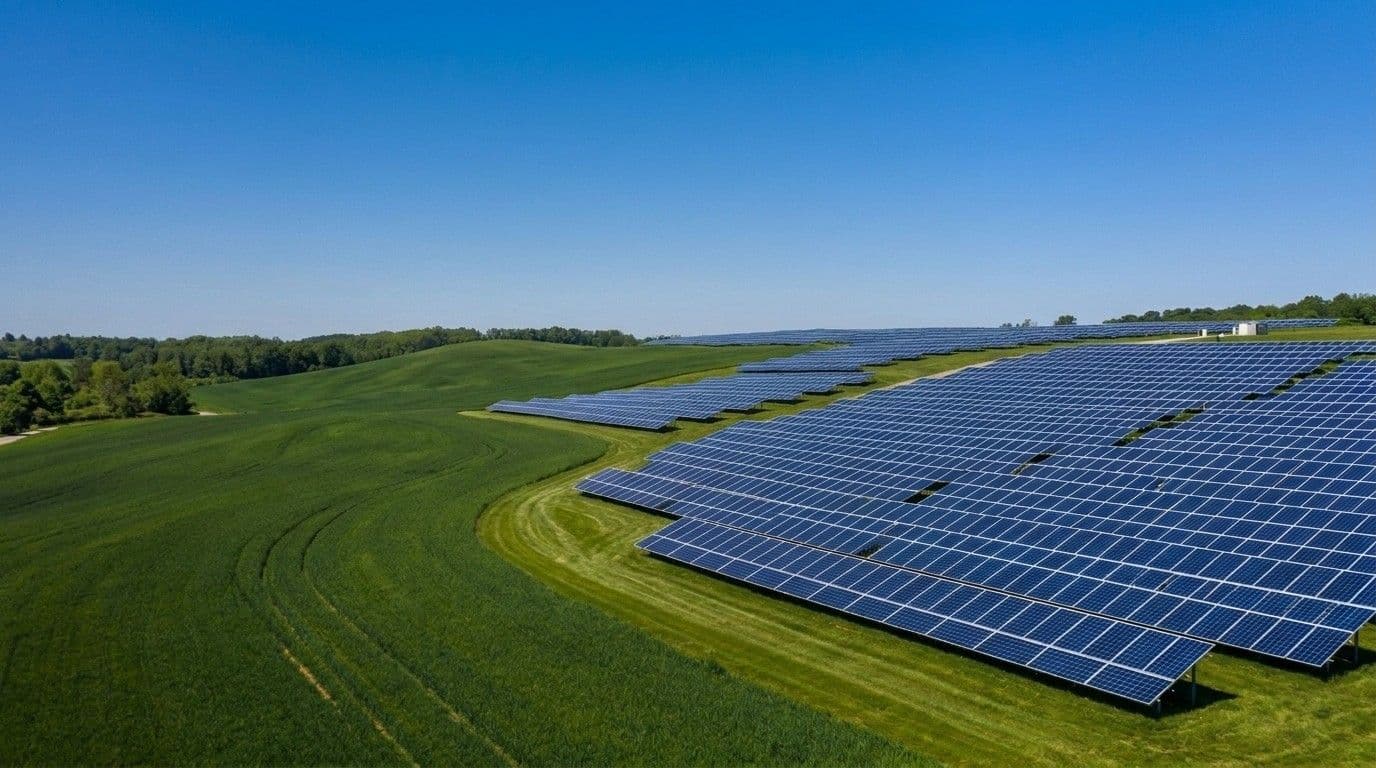
Ground-mounted solar systems
Got open land? See how ground-mounted solar systems can power your plant, farm, or portfolio — and what it actually takes to build one.
When a project needs serious output — megawatts, not kilowatts — rooftops usually run out of room fast. Ground-mounted solar systems solve that problem by using open land instead of limited roof space, which is why they power everything from captive industrial plants to utility-scale solar parks.
If you're evaluating land for a solar project, whether for a factory's own power needs, a solar farm, or dual-use agricultural land, this guide breaks down what ground-mounted solar systems actually involve, how they're engineered, and what to expect from planning through commissioning.
What are ground-mounted solar systems?
A ground-mounted solar system is exactly what it sounds like — panels installed on structures fixed directly into the ground, rather than on a building's roof. Because land isn't constrained the way a rooftop is, these systems can scale from a few hundred kW to hundreds of megawatts on the same basic design principle.
What makes ground-mounted different from rooftop solar
No roof load limits
Structure strength is engineered for the site, not constrained by existing building design.
Optimal tilt & orientation
Ground mounted solar panels can be angled precisely for maximum yield, unlike a fixed roof pitch.
Easier maintenance access
Technicians can walk the array without roof access equipment.
Room to scale
Additional capacity can often be added by extending the array, not re-engineering a roof.
Why industries and developers choose ground-mounted solar.
The decision to go ground-mounted usually comes down to one thing: the project needs more power than a rooftop can realistically deliver.
- 01
Why captive plants for industries use ground-mounted solar
Manufacturing plants with high, continuous energy demand often can't offset enough load from roof space alone. A captive ground mounted solar power plant, built on adjacent land, lets a factory generate a much larger share — sometimes all — of its own electricity, insulating operations from grid tariff hikes.
- 02
Why open-access solar farms rely on ground mounting
Open-access solar allows a business to buy power from a solar farm elsewhere and use it against their own electricity bill through the grid, even without owning land near their facility. These farms are almost always ground-mounted, since they're purpose-built on land selected specifically for solar yield rather than proximity to any one building.
- 03
Why utility-scale solar parks are built on the ground
At utility scale — tens to hundreds of megawatts — rooftop mounting isn't a realistic option at all. Utility-scale parks depend entirely on ground-mounted solar systems, engineered with tracking structures, high-voltage substations, and grid-evacuation infrastructure built directly into the project.
- 04
What makes agri-solar and dual-use land different
Agri-solar setups raise the ground mounted solar structure high enough, and space panels wide enough, for crops or grazing to continue underneath. This lets landowners generate solar revenue without taking farmland fully out of production — a growing model for dual-use land in India.
How is a ground-mounted solar structure engineered?
The structure is what separates a well-built ground-mounted system from one that fails early. It has to withstand wind loads, soil conditions, and years of thermal expansion and contraction.
What foundation types are used
Driven piles
Steel piles driven directly into stable soil, common for large flat sites.
Ballasted footings
Concrete blocks used where soil conditions or permitting restrict pile driving.
Helical piers
Screwed into the ground, useful for sites with mixed or looser soil.
What affects structure design
Local wind speed & cyclone exposure
Wind data and cyclone-zone classification drive member sizing and anchor design.
Soil bearing capacity
Tested through a geotechnical survey before the foundation type is finalised.
Row spacing
Set to avoid inter-row shading as the sun moves through the day and across seasons.
Tracking vs. fixed-tilt design
Changes load calculations significantly, so it's decided up-front, not late.
How does ground-mounted solar installation actually work?
Utility and industrial-scale projects follow a more involved sequence than rooftop solar, simply because land, structure, and grid connection all need separate planning.
Land and site assessment
Soil testing, topography survey, and shading analysis.
System design
Capacity planning, structure type, and layout optimised for the site.
Regulatory and grid approvals
Open-access, net metering, or grid-evacuation clearances depending on project type.
Civil and structural work
Foundations and mounting structures are installed first.
Panel and electrical installation
Panels, inverters, and cabling are installed and tested.
Commissioning
The plant is tested, connected, and handed over with monitoring in place.
Worth asking about: if you're comparing partners for solar panel installation in Hyderabad on a ground-mounted project, ask specifically about their experience with geotechnical survey and grid approval — these two steps most often determine whether a large project stays on schedule.
Why local execution experience matters at scale.
Ground-mounted projects, especially open-access and utility-scale ones, involve state-specific policy, DISCOM coordination, and land clearances that vary significantly by region. A team with direct solar panel installation in Hyderabad experience already understands local approval timelines and common site conditions before ground is even broken.
That local knowledge becomes more valuable, not less, as project size grows — a delay on a 50 MW project costs far more than the same delay on a rooftop installation.
Frequently asked questions.
What is the difference between rooftop and ground-mounted solar systems?
Rooftop systems are limited by available roof area and existing building structure, while ground-mounted solar systems are built on open land and can scale to much larger capacities with optimized panel angles.
How much land is needed for a ground mounted solar power plant?
As a general planning figure, roughly 4–5 acres are needed per MW of capacity, though this varies based on panel type, row spacing, and whether the design is fixed-tilt or tracking.
What is the lifespan of a ground-mounted solar structure?
A properly engineered structure, built with corrosion-resistant materials like hot-dip galvanised steel, typically lasts 25+ years alongside the panel warranty period.
Can agricultural land still be used after installing agri-solar panels?
Yes — agri-solar structures are raised and spaced specifically to allow crops or grazing to continue underneath, making it a dual-use model rather than a land-use trade-off.
How long does a utility-scale ground-mounted project take to build?
Timelines vary widely by capacity, but utility-scale parks typically take several months to over a year from land clearance to commissioning, largely driven by grid approval and civil work timelines.
Ready to build on the ground?
Ground-mounted solar systems exist because scale eventually outgrows the roof — and whether you're powering a factory, developing a solar farm, building a utility park, or putting idle land to dual use, the right structure and site planning make the difference between a project that performs for 25 years and one that underdelivers from year one.
Get in touch with our team for a consultation on your land, load, and project goals — we'll help you understand exactly what a ground-mounted solar system would look like on your site.
Request a Land Consultation