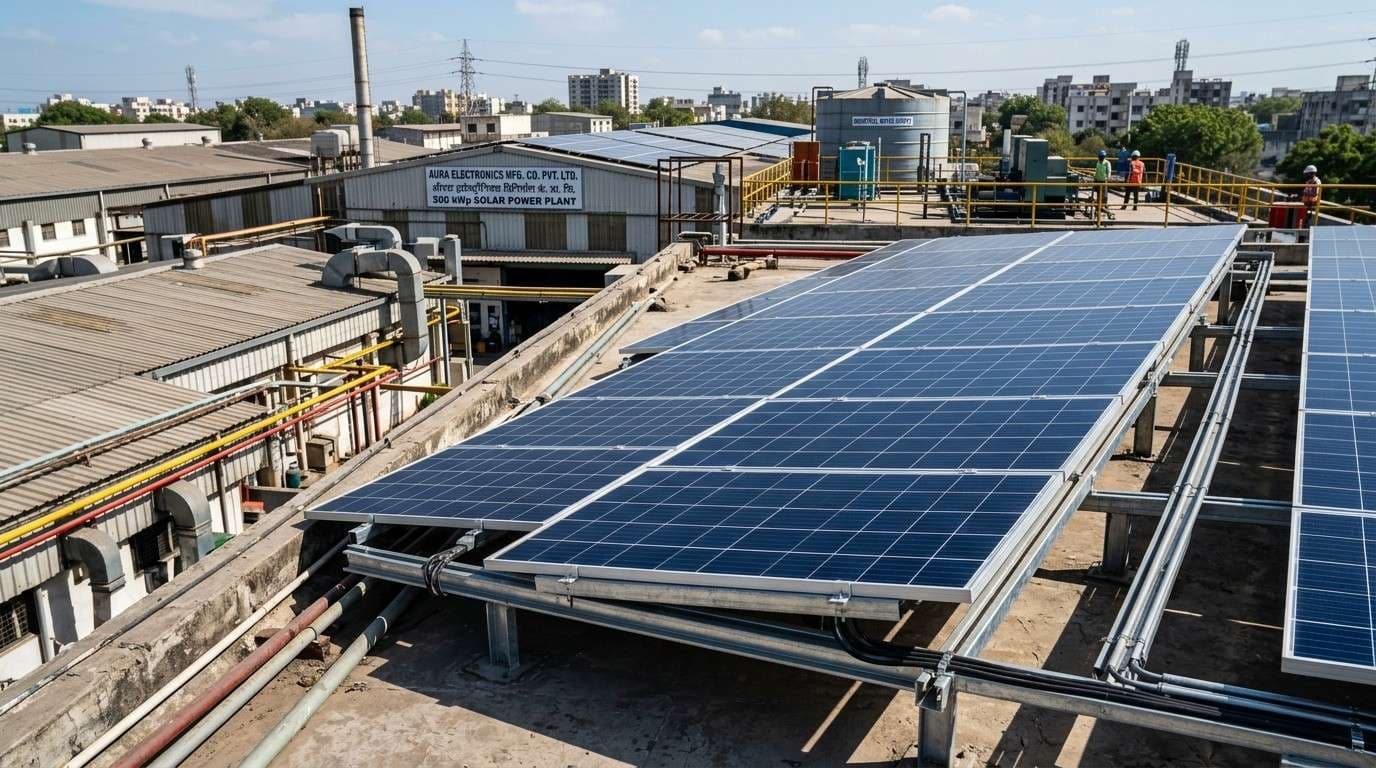
Why industrial facilities get faster payback than everyone else.
Residential solar takes 5 to 7 years to pay for itself in most cases. Industrial rooftop solar often does it in half that. The reason isn't magic — it's just timing.
Factories and warehouses draw their heaviest load during the day, which happens to be exactly when solar panels generate the most power. A home draws most of its power in the evening, after the sun's already down, so residential systems are always fighting a mismatch. Industrial facilities don't have that problem.
Three things stack in your favour here. Daytime-heavy consumption means the power you generate gets used immediately instead of exported for credit. Commercial tariffs run higher than residential ones, so every solar unit displaces a more expensive grid unit. And factory roofs are usually wide open — no trees, no neighbouring shadows, nothing eating into your generation the way residential rooftops often do.
- 1Load audit before roof measurement
- 2Structural assessment for metal, RCC & PEB roofs
- 3Net metering or open-access, whichever suits your tariff
- 4Ongoing monitoring & AMC included
Why the payback lands, and how it gets built.
Daytime load matches generation
Factories and warehouses draw their heaviest load during the day, which happens to be exactly when solar panels generate the most power. A home draws most of its power in the evening — so residential systems are always fighting a mismatch, and industrial facilities don't have that problem.
Every unit displaces a costlier one
Commercial tariffs run higher than residential ones, so every solar unit displaces a more expensive grid unit. And daytime-heavy consumption means the power you generate gets used immediately instead of exported for credit.
Clean, unshaded roof area
Factory roofs are usually wide open — no trees, no neighbouring shadows, nothing eating into your generation the way residential rooftops often do.
It starts with a load audit, not a roof measurement
We look at your monthly consumption pattern, your peak demand charges, and whether you're on a flat tariff or time-of-day billing. That last part changes the payback math more than people expect.
The roof itself decides the mounting approach
Metal sheet roofs, RCC slabs, and pre-engineered building structures each need different hardware. A cold storage unit with insulated panel roofing is a completely different install from a textile shed with exposed metal sheeting, and getting this wrong either damages the roof or shortens the system's life. Not a small mistake to make.
Grid connection comes last, and it's not always the obvious choice
Most industrial solar energy systems tie into the grid and earn net metering credit for excess generation. But if you're in an industrial cluster, an open-access power purchase agreement can sometimes beat net metering outright. Worth checking both before you commit to one.
Where the numbers work hardest.
Manufacturing units & SMEs
Running single or double shifts see the cleanest payback of the whole group, since production hours line up almost exactly with generation hours. Three-shift operations with heavy night load shift the math, though a hybrid setup with battery storage can still make it work.
Warehouses & cold storage
Get underrated constantly. Cold storage compressors run continuously, and solar can offset a real chunk of that load directly — which usually means cutting one of the biggest line items on the entire electricity bill.
MSMEs & cluster facilities
Often qualify for extra state-level incentives on top of the standard subsidy, and when several units in the same industrial estate go solar together, cluster procurement tends to bring the per-unit cost down for everyone involved.
Food & textile processing plants
Typically run high, steady loads for drying, refrigeration, or dyeing. These facilities tend to post some of the fastest payback periods we see in industrial solar panel projects, mostly because their baseline consumption never really dips.
See what a real installation would look like on your site.
An industrial solar rooftop decision shouldn't be made from a brochure. It starts with an honest look at your load profile, your roof, and your actual electricity bill — not a benchmark from a different industry entirely. Share yours, and we'll come back with what a real installation looks like on your specific site, sized to what you actually use, not oversold on capacity that sits idle.
What to actually ask before you buy solar panels for industrial use.
A few questions that separate a serious vendor from a sales pitch:
- 1
What's the real payback period for your specific load — not a generic industry average someone pulled off a slide deck.
- 2
Who does the structural assessment of your roof, and is that actually included in the quote?
- 3
What happens to your warranty if the roof needs repair partway through the system's life?
- 4
Are you eligible for open-access, or only net metering — and which one actually suits your tariff better?
- 5
What does ongoing monitoring and AMC look like once the system's running?
Rule of thumb: if a vendor can't answer these clearly before quoting a number, that's worth noticing before you sign.
Frequently asked questions.
How much roof space does an industrial solar rooftop system actually need?
As a rough rule, 1 kW needs about 80–100 sq ft of usable roof area, so a 100 kW system needs roughly 8,000–10,000 sq ft. Actual numbers shift depending on panel efficiency and how much of your roof is already taken up by HVAC units, water tanks, or skylights.
Does an industrial solar panel system work if my facility runs multiple shifts?
It depends on the shift pattern. Single and double shifts line up well with daylight generation, so payback stays strong. Round-the-clock three-shift operations see less direct benefit from solar alone, though pairing the system with battery storage can still make the economics work.
Is my roof strong enough for industrial rooftop solar, or does it need reinforcement?
That's exactly what the structural assessment is for, and it should happen before anyone quotes you a number, not after. Metal sheet roofs, RCC slabs, and PEB structures all carry different load limits, and skipping this step is one of the more common ways industrial installs go wrong.
What's the difference between net metering and open access for industrial solar energy?
Net metering credits your bill for excess power you feed back to the grid, and works well for most standalone facilities. Open access lets you buy and sell power more flexibly, often at better rates, and tends to suit facilities inside industrial clusters or estates. Which one wins depends on your specific tariff structure, not a blanket rule.
How long does installation actually take once we sign off?
Most industrial installations run 4 to 8 weeks from site assessment to commissioning, depending on system size and how quickly your DISCOM processes the net metering or open-access paperwork. The physical installation itself is usually the fastest part of that timeline.
Are there subsidies available for solar panels for industrial use?
Direct capital subsidies are more limited for industrial and commercial installations compared to residential schemes like PM Surya Ghar, but MSMEs and cluster facilities often qualify for state-level incentives, accelerated depreciation benefits, or reduced GST on components. Worth checking what your specific state and facility category qualify for before assuming there's nothing available.