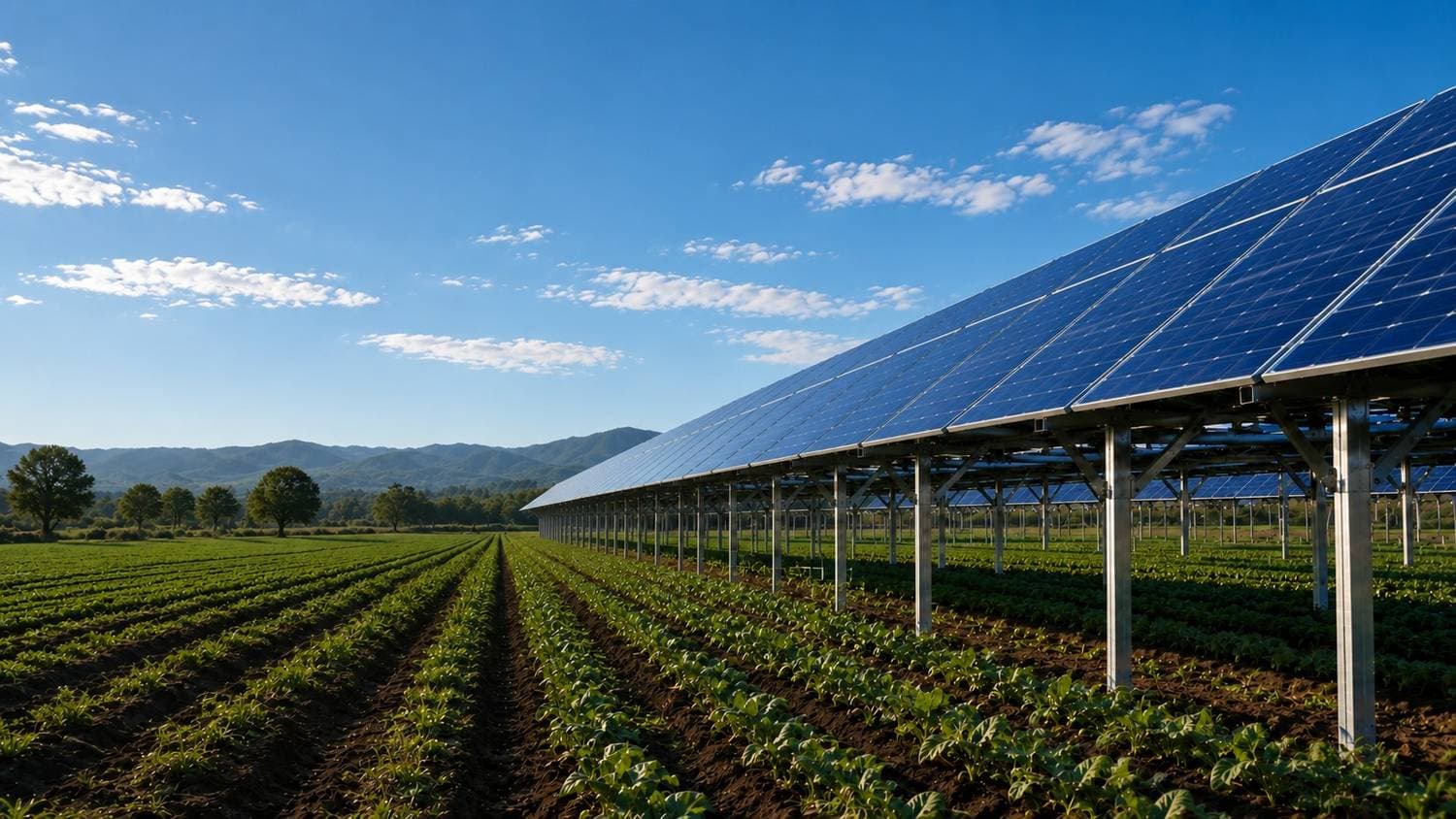
What agrivoltaics actually is.
Agrivoltaics means using one plot of land for both solar generation and farming, at the same time, not in rotation. Bifacial panels get mounted 2.5 to 5 metres up, spaced 8 to 12 metres apart, high and wide enough that sunlight still reaches the crop, rain still gets through, and a tractor can drive underneath without anyone ducking.
Compare that to a standard farm solar panel setup. Those sit low, packed close together, and take up land that would otherwise be growing something. Agrivoltaics doesn't make that trade — panels and crop share the same square metre instead of splitting the field into “solar side” and “farming side.”
There's a side effect worth knowing too. The shade cools the microclimate underneath and holds soil moisture longer than open field would, which happens to be exactly what struggles most in Indian summer heat: leafy greens, tomatoes, chillies, potatoes, berries, turmeric, several pulses. The panels aren't just tolerated by these crops — in a lot of cases they help.
- 1Elevated bifacial panels — 2.5–5 m clearance
- 2Wide-spaced rows (8–12 m) for full machinery access
- 3Shade tuned to crop type — leafy, fruit or pulses
- 4Grid export, captive use or PM-KUSUM tariff
Six things stack in agrivoltaics' favour.
Your land does two jobs, and the combined output beats either one alone
Fraunhofer ISE trials, backed by Indian pilot data, put combined food-plus-electricity output 60 to 70% above single-use land. You're not picking crops or power — same acre, both incomes.
You'll water less
Shade cuts soil evaporation, tested systems show 20 to 30% lower irrigation demand. The panels can even run the borewell or drip pump directly, so the setup closes its own loop without extra infrastructure.
Crops get shielded from the worst of it
45°C summers aren't rare anymore, and panels take the edge off peak heat, hail, and unseasonal storms. Shade-tolerant crops, which is most of what grows well in Indian conditions anyway, often do better under filtered light than in raw, direct sun.
There's real money on the table through subsidy
This is where agriculture solar panel subsidy support does the heavy lifting. PM-KUSUM Component-C feeder solarisation, state DISCOM tariffs, open-access PPAs — all viable routes to sell surplus power. Realistic range: ₹60,000 to ₹1,00,000 per acre per year, stacked on top of whatever the crop already earns.
Your equipment still fits
Structures are built for tractor and harvester clearance from day one, minimum 4 metres for mechanised crops, up to 5–6 for orchard gear. Nothing about how you farm has to change just because there's now a solar array overhead.
Even the panels perform better here
Elevated bifacial modules catch reflected light bouncing off the crop canopy below, generation runs 8 to 15% higher than conventional ground-mount solar power for agriculture. More output, same panel count, less land eaten up per kWp.
Farms, FPOs, and solar developers.
Individual farms (1–10 acres)
Captive systems powering the farmhouse and irrigation, surplus sold to the grid.
Farmer Producer Organisations (FPOs)
Cluster-scale 1 to 5 MW plants pooled across member farms. We handle the land aggregation and DISCOM paperwork.
Horticulture & polyhouse operations
Tomato, capsicum, strawberry, leafy greens, floriculture benefit the most — since the same shade protecting the crop also runs the polyhouse fans and cold storage.
Solar developers & open-access IPPs
5 to 25 MW plants leased on farmland — landowners keep farming and collect lease plus crop income at once.
See what your land could actually earn.
Tell us your acreage, soil, water source, and what you're growing. We'll come back with a feasibility report, indicative capacity, PM-KUSUM eligibility, and a payback model that accounts for crop income and electricity income together — not just one or the other.
How it actually gets built.
- 1
Site visit comes first. We look at acreage, soil, water source, and whatever you're growing or planning to grow, since shade tolerance varies a lot by crop and that decision drives everything downstream — spacing, height, structure design.
- 2
From there, the structure gets engineered around your actual machinery, not a generic template. If you run a harvester, that clearance requirement shapes the whole layout before a single panel gets specified.
- 3
PM-KUSUM eligibility gets checked next. Most individual farms between 500 kW and 2 MW qualify under Component-A, and we handle that paperwork so it doesn't become a second full-time job for you on top of running the farm.
- 4
Installation itself is built to minimise disruption. Panels go up well above working height for standard equipment, so cultivation doesn't pause for construction any longer than it has to.
- 5
Then you choose how the power gets used. Some farms run everything captive — farmhouse, cold storage, irrigation pumps — straight off the system. Others export surplus to the grid. Most land somewhere in between, and we help figure out which split actually makes sense for your specific operation.
- 6
After that, it's just two income streams running in parallel. Crop revenue continues exactly as it always has. Solar revenue sits on top, either as savings on power you'd otherwise be buying, or as tariff income from what you export.
Frequently asked questions.
How's this different from a regular agriculture solar panel setup?
Regular farm solar panel installations sit low and dense, using up land that would otherwise grow crops. Agrivoltaics elevates and spaces the panels so farming continues underneath — both outputs, same land, instead of picking one.
Is there subsidy support for this in India?
Yes. PM-KUSUM Component-A covers individual farms between 500 kW and 2 MW, and Component-C supports selling surplus power at the feeder level. We handle the agriculture solar panel subsidy eligibility and paperwork as part of the build.
Does panel shade actually hurt the crop?
Usually not, and often it helps. Lettuce showed 17 to 33% higher yield under panel shade in trials, potatoes up to 20%, mostly because the cooler, moister microclimate suits these crops better than open, direct sun does.
How much land do I actually need?
Individual systems typically start around 1 acre. FPO cluster projects run 1 to 5 MW across pooled farmland. We'll look at your specific plot and tell you plainly whether it's a fit before quoting anything — this isn't a one-size deal.
Can I still run my tractor and harvester like normal?
Yes — that's designed in from the start, not bolted on after. Minimum 4-metre clearance for mechanised crops, 5 to 6 metres for orchard equipment. Your operations don't have to adjust around the panels.