On-Grid Solar Systems
for every Indian rooftop.
Solar that talks to your grid.
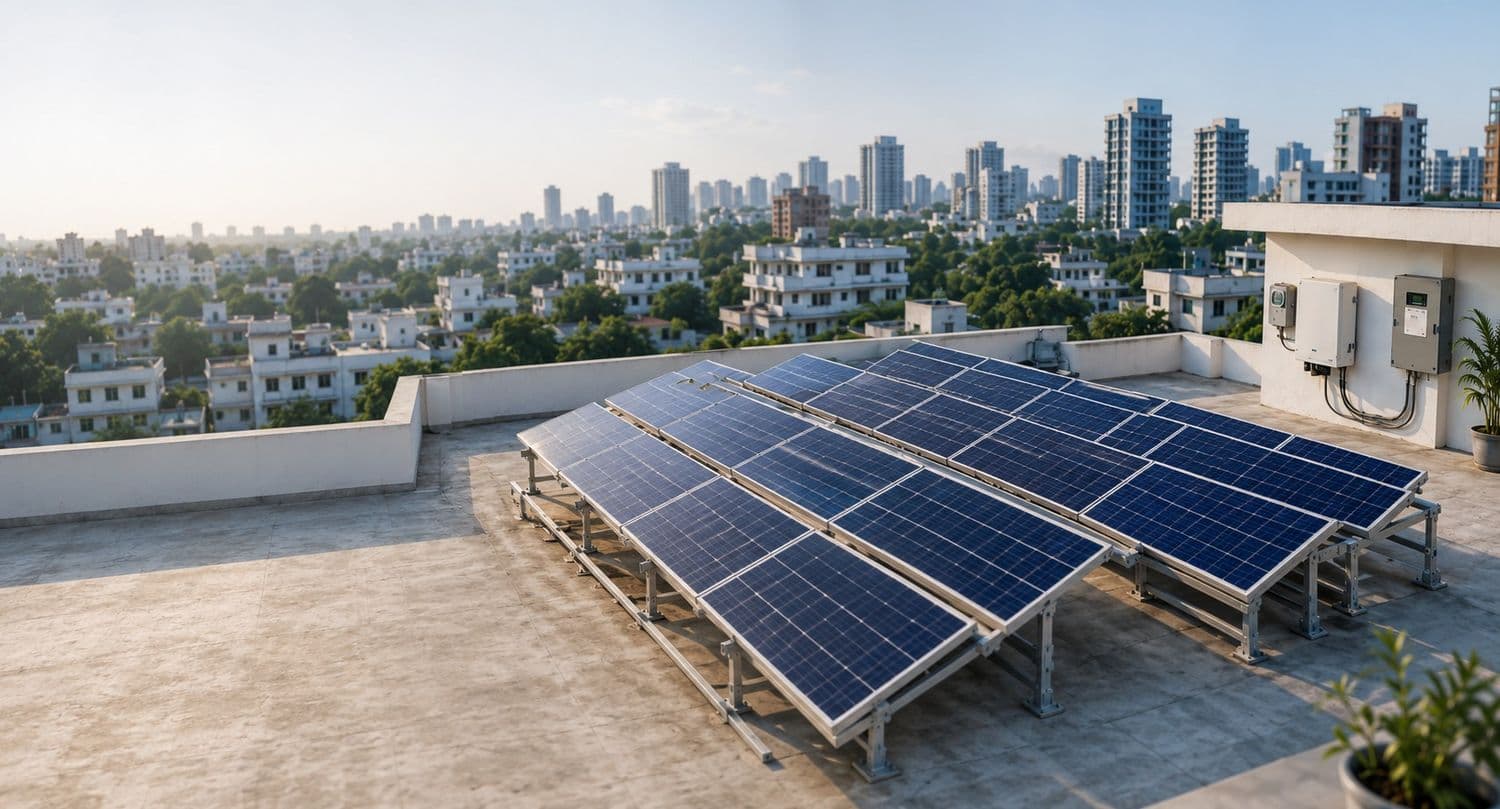
An on-grid (also called grid-tied) solar system is the most common rooftop setup in India. It keeps your home connected to the utility grid while quietly generating clean electricity from your roof — so you draw less from the grid and pay less to the utility.
Most Indian households on a reliable grid choose on-grid because it's the cheapest of the three solar system types, the only one eligible for PM Surya Ghar subsidy, and the simplest to operate — no batteries, no maintenance theatre, just solid savings every month.
- 1Solar Panels
- 2Solar Inverter
- 3Mounting Structures
- 4Bi-Directional Meter
- 5Cables & Combiner Boxes
Sunlight to savings in 5 steps.
Once installed, your on-grid system runs automatically — feeding your home, feeding the grid, and crediting your bill.
Sunlight hits the panels
Photovoltaic cells convert solar radiation into DC electricity.
Inverter does the work
DC current is converted into clean, grid-ready AC current.
Powers your home first
Your appliances draw from solar before touching grid power.
Surplus flows to the grid
Whatever you don't use is exported to your utility — and credited to you.
Grid returns it at night
After sundown, your meter pulls the units back as needed.
The five parts of every on-grid system.
We use only tier-1 components — because the cheapest part is also the first one to fail.
Solar Panels
High-efficiency monocrystalline panels mounted on your roof, ideally facing south. They absorb sunlight and convert it into DC electricity — the foundation of the entire system.
Solar Inverter
The brain of the system. It converts the DC power generated by the panels into the AC power your home appliances actually use, while also feeding the grid when there is surplus.
Mounting Structures
Engineered, hot-dip galvanised steel structures designed to survive Indian wind loads for 25+ years. Our prefabricated mounts hold the panels at the optimal tilt without rust or fatigue.
Bi-Directional Meter
A smart utility meter that records both the electricity you export to the grid and what you import from it. This is what makes net metering possible.
Cables & Combiner Boxes
MC4-connected DC cables, AC cables, plus DC and AC combiner boxes that safely isolate high-voltage feeds. Complete with proper earthing — the unseen work that makes the system safe.
See what your bill actually looks like.
Here's a sample monthly bill from a 5 kW solar home in Hyderabad — showing exactly how net metering collapses a ₹4,960 bill down to ₹320.
How the math works
The meter watches both directions
Every unit your solar exports to the grid is logged. Every unit you draw back from the grid is also logged. No paperwork — it's automatic.
Discom balances at month-end
Exported minus imported = the net. If you exported more, the surplus is credited to your next bill or rolled forward.
You pay only the net
At your normal tariff — nothing extra. Most solar homes pay a tiny fixed-charge bill, or nothing at all.
* Illustrative example. Actual numbers depend on your tariff, generation, consumption pattern, and how your discom rolls over credits.
Choose your size, see your savings.
Annual numbers based on average Indian solar irradiance and a ₹8/unit electricity tariff.
* Numbers are indicative averages. Actual generation depends on your location, roof orientation, shading, and weather. Real-world bills depend on your local tariff and usage pattern.
PM Surya Ghar Yojana subsidy.
The central government offers a direct subsidy on residential rooftop solar installations using DCR (Made-in-India) panels — credited directly to your bank account after commissioning.
We handle the entire subsidy application — load change, net-meter approval, documentation, and follow-up — at zero cost to you. You just sign where we point.
Check My SubsidyA 5 kW system earns you ₹11+ lakhs.
Here's how the numbers work for a typical Hyderabad household.
Total cost of a 5 kW system after the ₹78,000 PM Surya Ghar subsidy.
At ₹8/unit tariff & 600 units/month, your system pays for itself.
Minimum savings over the panel lifetime — actually more, since power tariffs rise 3–5% per year.
Six reasons most Indian homes pick on-grid.
Lowest upfront cost
Of the three solar system types, on-grid is the most affordable because there is no battery bank to buy or replace.
Govt. subsidy eligible
The PM Surya Ghar Yojana offers up to ₹78,000 for systems above 3 kW — only available for on-grid residential installations.
3–5 year payback
After the system pays for itself, you enjoy 20+ years of essentially free solar electricity — guaranteed by panel warranty.
No battery hassle
The grid acts as your virtual battery. No replacements every 5–7 years, no chemistry to maintain, no failure points.
Simple billing
Net metering makes your solar accounting transparent — every month you see exactly how many units you exported and imported.
Track everything live
Real-time generation, usage, savings, and CO₂ offset numbers in your hand — through Kamala Power's monitoring app.
One honest limitation
When the grid goes down, an on-grid system also shuts off — by design. This safety feature, called anti-islanding protection, prevents your panels from electrocuting utility workers repairing the line. If your area sees frequent power cuts and you need backup, ask us about hybrid solar instead.
More than just panels on your roof.
The cheapest install isn't the best deal — fixing a bad install costs more than doing it right the first time. Here's what we include, always.
Ready to start earning from your roof?
Book a free site visit with our solar consultants — we'll measure your roof, study your bill, and design a system that pays you back fast.